
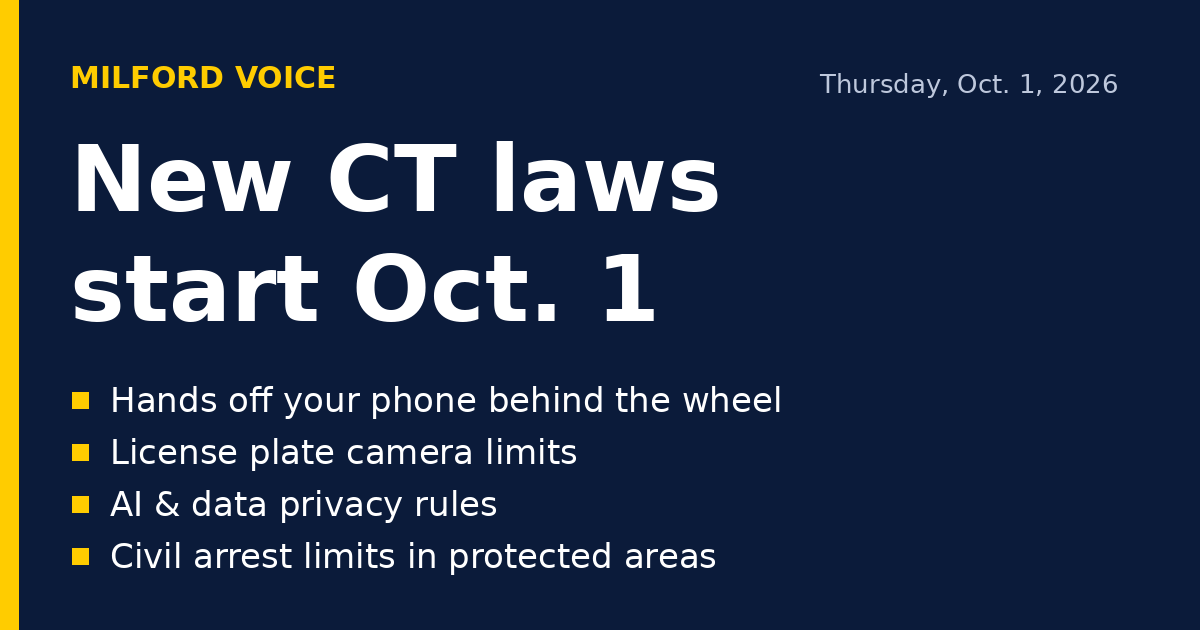
Starting Thursday, Oct. 1, just holding your phone while you drive breaks Connecticut law. That includes sitting at a red light on the Boston Post Road or crawling along I-95 in traffic. The phone rule is one of nearly 100 state laws that take effect in whole or in part on Oct. 1, according to CT Mirror.
Several of the new laws hit close to home in Milford, Orange, Stratford and West Haven. They include new limits on license plate reader cameras like the ones Milford has argued about all summer, new AI and data privacy protections led by Milford’s own state senator, and limits on civil arrests at schools, hospitals and town buildings. Below, we explain what each law does, based on the text of the laws, and what it means for you.
The phone law: hands off, even at a red light

Until now, Connecticut’s distracted-driving law mostly covered talking on a hand-held phone and texting. Public Act 26-63, which Gov. Ned Lamont signed May 27, rewrites that law. Starting Oct. 1, you may not drive while:
- holding or supporting a phone or other mobile electronic device with any part of your body;
- using a device that is not in hands-free mode;
- reading, viewing or typing a text or other non-voice message; or
- a video or moving image is visible from the driver’s seat, whether it’s on a phone or on a screen built into the car.
Under the law, you are still “operating” your car when you are stopped for a moment because of traffic, road conditions, a stop sign or a traffic light. To pick up your phone legally, you need to be parked on the side or shoulder of the road where you can safely stay put. CT Mirror reported that the change is meant to cover things like scrolling, not just calls and texts.
Still allowed: a navigation map on a device mounted to the windshield, dashboard or center console; backup cameras, parking cameras and other driver-assist screens; and hands-free calls. Under the new definition, hands-free mode allows a single touch or swipe to start or end a call. You can still call 911, a hospital, a doctor’s office, an ambulance company, a fire department or the police about an emergency.
Teen drivers: Drivers under 18 face a stricter rule. They may not use a mobile device at all while driving, even hands-free, except for emergency calls.

What a ticket costs
The fines written into the statute are $200 for a first violation, $375 for a second and $625 for a third or later. Those amounts are not new. What changes on Oct. 1 is the list of things that can get you a ticket. Violations show up on your driving record, and insurance companies can see that record. When a local police officer writes the ticket, the state sends 25% of the fine back to that town. For drivers under 18, state law also calls for a license suspension: 30 days for a first violation, 90 days for a second and six months for a third.
Distracted in a work zone? That’s now reckless driving
A separate law, Public Act 26-120, treats distracted driving in a highway work zone as reckless driving. That is a criminal charge, not just a ticket. A first offense carries a fine of $100 to $300, up to 30 days in jail, or both. A later offense can bring a fine of up to $600, up to a year in jail, or both. You can’t be prosecuted under both the distracted-driving law and the reckless-driving law for the same incident. Under existing state law, a reckless driving conviction also means a license suspension of 30 to 90 days.
Other road rules that change Oct. 1
- Loud exhaust: The fine for breaking the state’s vehicle noise and muffler law doubles, from $150 to $300 per offense (Public Act 26-63).
- Storm travel bans: Ignoring a governor’s order restricting travel during extreme weather can now bring a fine of up to $250 (Public Act 26-63).
- School buses: A third or later conviction for illegally passing a stopped school bus with its red lights flashing brings a six-month license suspension, which the DMV imposes without a hearing (Public Act 26-95). WSHU and CT News Junkie reported that the suspension does not apply to tickets from school bus cameras.
License plate cameras: a 21-day limit and new sharing rules
This one matters a lot in Milford. The city has had 33 Flock automated license plate readers and has become one of the state’s loudest battlegrounds over them, as Milford Voice reported Sept. 8. The new rules are in Public Act 26-14, signed May 4. Starting Oct. 1, the law:
- Caps storage at 21 days. Police, other public agencies and their vendors can keep plate-reader data for up to 21 days. They can keep it longer only for narrow reasons, such as a warrant or court order, or as evidence in an active criminal case when a supervisor approves and documents it. Our Sept. 8 story reported that Milford’s Flock data was being kept for 30 days.
- Limits what police can use it for. Allowed uses include checking plates against wanted, stolen-vehicle and missing-person lists, and searching for a plate linked to an active criminal investigation, an outstanding warrant, a missing or endangered person or a stolen car. For investigative searches, officers must record the reason and a case number.
- Bans certain uses. The data can’t be used for immigration enforcement, to identify people taking part in activity protected by the First Amendment, or to investigate people who seek, receive or provide reproductive or gender-affirming health care that is legal in Connecticut.
- Limits sharing. Connecticut agencies can share data with each other. They can also share with police in New York, Massachusetts and Rhode Island, but only if those agencies promise in writing to follow Connecticut’s rules. Any other agency, including federal agencies, needs a judicial warrant. The one exception is a possible match on the federal terrorist screening list.
What it means for residents: Camera locations are public records under the law, except for cameras bought with certain federal Homeland Security money that came with a condition that locations stay secret. You can ask for the plate-reader data about a vehicle registered in your name. Starting Oct. 1, people can sue a public agency to stop violations. The state’s Police Officer Standards and Training Council (POST) must adopt a model policy for police by Dec. 1.
| Sponsored Partner |
 Make Your Car’s Wired CarPlay WirelessPlug it in once. Your phone connects when you start the car.DrivePair · See more › |
| Milford Voice may be paid a small commission on partner offers at no cost to you. |


Where Milford stands
On Sept. 14, the Board of Aldermen voted 9-6 against a full ban on the Flock cameras, WFSB reported. The board created a Public Safety Technology Review Committee instead. The Milford-Orange Times reported that the committee has 90 days to review the city’s cameras and police drones and could recommend ending some or all of those programs. In late August, at Mayor Rich Smith’s request, the city suspended its red light and speed cameras and restricted license plate readers except at Milford’s entry points, the Times reported. WFSB reported that cameras will remain active at the city’s borders and schools.
Critics want the cameras gone. “Get the cameras off, unplug them, turn them off,” Susan Bedworth of Milford told the board, according to WFSB. “There is no acceptable amount of mass surveillance,” said Molly Paulus, also of Milford. Aldermen who voted against a shutdown said the technology is critical for public safety and that Connecticut regulates third-party surveillance cameras more than other states do, WFSB reported.
Milford Police Chief Keith Mello also chairs POST, which on Sept. 24 sent Gov. Lamont a report recommending stricter rules, including a seven-day storage limit, CT Mirror reported. “Our recommendations are advisory and do not override state law,” Mello said. He defended the technology: “Connecticut police departments use these systems to find missing and endangered people, identify stolen vehicles, locate suspects and build evidence in homicides, sexual assaults, robberies and other violent crimes. These cases are real, and there are many.” State Sen. James Maroney, D-Milford, one of the authors of the Oct. 1 law, told CT Mirror: “We are mostly ahead of the curve in terms of legislation and behind the curve in terms of technology.”
AI and data privacy: new rights from a Milford senator’s bills
Maroney was the “lead architect” of two laws Lamont signed May 27, CT Mirror reported. One is Public Act 26-64, which expands the Connecticut Data Privacy Act. The other is Public Act 26-15, the Connecticut Artificial Intelligence Responsibility and Transparency (CART) Act. According to Attorney General William Tong’s office, the privacy law gives consumers these new rights starting Oct. 1:
- Limits on “surveillance pricing,” plus disclosure rules for businesses that use your personal data to set prices.
- Businesses that use facial recognition must post clearly readable signs saying so, with a link or QR code to their facial recognition policy.
- New consent rules for at-home genetic testing companies. Consumers get a property right and exclusive control over their samples and results.
- A ban on selling consumers’ precise geolocation data.
- A new registry for data brokers, who must register with the state Department of Consumer Protection by Jan. 1, 2027.
The AG’s office notes that not every business is covered by the data privacy act, which has revenue thresholds and exempts some industries.
Here is what the AI law does starting Oct. 1: Companies that sell AI subscriptions must give customers written notice of key terms and limits before charging them. Workers at large “frontier” AI developers get new whistleblower protections. And employers that file layoff notices with the state Labor Department must say whether the layoffs are related to AI. Other parts phase in later. Duties for employers that use AI hiring tools apply to tools put in place starting Oct. 1, 2027. Safeguards for AI companion chatbots, including protections for kids, begin Jan. 1, 2027. Rules for minors on social media begin Jan. 1, 2028.
“This is a start. This is not a finish; this is not a ceiling. This is the floor,” Maroney said at a recent press conference, according to CT Mirror. Tong called the laws “significant steps to protect our kids from dangerous chatbots, safeguard our privacy, and prevent unfair pricing practices.” The Connecticut Business and Industry Association opposed parts of the AI law. “These provisions could unintentionally penalize employers for using common, lawful tools,” said CBIA’s Chris Davis, in a May statement. “Connecticut needs to focus on preparing workers and employers for the AI economy, not chasing that innovation out of state with state-specific regulations.”
Civil arrests: new limits at schools, hospitals and town buildings
Public Act 26-14 also creates “protected areas” starting Oct. 1. Under Section 7 of the law, no peace officer may detain or arrest someone for a civil offense, such as an immigration violation, in a protected area, a state facility or a municipal facility unless that person is named in a judicial warrant. Protected areas include:
- schools, from preschools through colleges;
- hospitals and urgent care centers;
- places of worship;
- playgrounds, recreation centers, child care centers and school bus stops when children are present;
- shelters, food banks, treatment programs and other social service sites;
- disaster-relief sites and cemeteries.
The rule also covers the parking lots and garages those places use. A municipal facility is any building a town government owns, leases or uses, along with its grounds and parking. The law does not change arrests for crimes that can bring jail time, or for motor vehicle violations. People who believe the rule was broken can sue in Superior Court. A separate part of the law, which lets residents sue federal and state officers for violating their constitutional rights, took effect when the law was signed in May.
The law is already being tested nearby. This month, immigration agents arrested travelers at Tweed New Haven Airport, the closest commercial airport to our towns. New Haven’s mayor argues that the law applies at Tweed because it is a municipal facility, and the airport authority says it is reviewing the question. Read our full Tweed story.
Supporters say the law protects people’s safety and rights. “The people of Connecticut should not fear for their safety when visiting hospitals, schools, and religious and government buildings,” Lamont said when the bill passed, CT Mirror reported. Rep. Steven Stafstrom, D-Bridgeport, called the bill “a very measured response to federal overreach.” Republicans opposed it. House Minority Leader Vincent Candelora, R-North Branford, argued that the U.S. Constitution’s Supremacy Clause keeps states from regulating federal immigration officers. “The state of Connecticut is, in effect, saying to federal law enforcement, ‘We don’t want you within our borders. We don’t want you enforcing federal law,'” said Rep. Craig Fishbein, R-Wallingford, who predicted a court challenge. The bill passed the House 91-53.
KEY FACTS
- Effective: Thursday, Oct. 1, 2026.
- Phones (PA 26-63): No holding or supporting a device while driving, even when stopped in traffic or at a light. Mounted navigation, hands-free calls and emergency calls are allowed. Fines are $200, then $375, then $625.
- Work zones (PA 26-120): Distracted driving in a highway work zone counts as reckless driving, with up to 30 days in jail for a first offense.
- Also on the road: The loud-exhaust fine goes from $150 to $300. Ignoring a storm travel ban can cost up to $250. A third school bus passing conviction brings a six-month suspension.
- Plate readers (PA 26-14): 21-day storage limit, no use for immigration enforcement, and limits on sharing outside CT, NY, MA and RI.
- Privacy and AI (PA 26-64, PA 26-15): Facial recognition signs, a ban on selling precise geolocation data, surveillance pricing limits, and AI subscription disclosures.
- Civil arrests (PA 26-14): A judicial warrant is required for civil arrests at schools, hospitals, houses of worship, town buildings and other protected areas.
Reader poll: Which new Oct. 1 law will affect you most?
Get Milford’s best stories first — subscribe to the free Milford Voice newsletter
Got a tip? Email news@milfordvoice.com
| More from our Sponsored Partners |
| Milford Voice may be paid a small commission on partner offers at no cost to you. |




1 Comment
Comments are closed.